Slab Foundation Repair in Houston, TX
Most Houston homes built since the 1980s sit on a concrete slab-on-grade foundation. When the clay underneath swells and shrinks with the seasons, the slab cracks, dips, or heaves along with it. We measure exactly how far it has moved, then lift it back into place with engineered steel push piers — $0 down and 0% APR for 18 months.
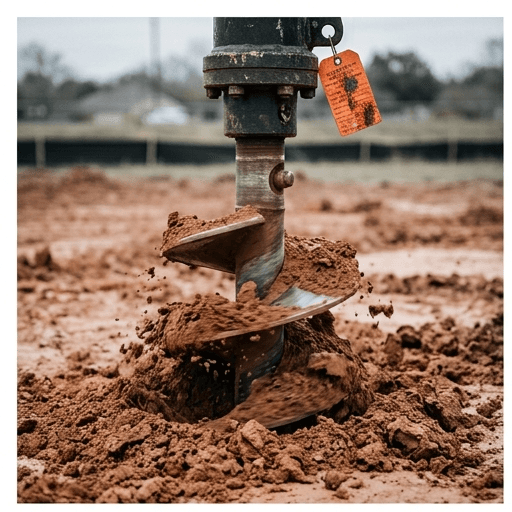
Piers driven to refusal depth, not a fixed number — the auger stops when the clay says stop, not before.
Conventional slab vs. post-tension slab
Conventional reinforced slab
Rebar-reinforced concrete, common in older Houston construction. Failure shows up as visible cracks — diagonal stair-stepping through brick, straight cracks through sheetrock — as one section of the slab settles relative to another.
Post-tension slab
Steel cables run through the slab under tension, resisting the differential cracking that damages conventional slabs. The dominant modern-construction type — but it fails differently: cable corrosion or anchor failure rather than a simple crack. We locate cable runs before placing a single pier.
Engineered push piers, not guesswork
We drive steel or helical piers through the soil to load-bearing strata below the slab, then use hydraulic jacks to lift the affected section back toward its original elevation. Pier count and placement come off a floor elevation survey and are reviewed by a licensed structural engineer — not set by eye.
- Diagonal stair-step cracks in brick veneer or mortar joints
- Straight cracks running through interior sheetrock or drywall
- Doors and windows that stick or won't latch flush
- Tile grout lines separating or tile cracking in a line
- A section of floor that feels lower or higher than the rest
- Gaps opening between baseboards and the floor
A lifted slab that sits on the same poorly-draining soil will eventually move again. Where drainage is part of the problem, we flag it as part of the same evaluation — not a separate upsell after the fact.
Slab repair questions
- How do you fix a cracked slab foundation?
- We drive steel or helical push piers to load-bearing strata beneath the slab, then lift and stabilize the affected section. Crack width and pier count come off a floor elevation survey, not a visual walk-around.
- Is post-tension slab repair different from a regular slab?
- Yes. Post-tension slabs have steel cables under tension running through the concrete, which resist cracking better than older slabs but fail differently — cable corrosion or anchor failure rather than simple cracking. We locate cable runs before any pier placement to avoid cutting a live cable.
- How much does slab foundation repair cost in Houston?
- Typical Houston slab repairs run a few thousand dollars for localized leveling up to $15,000+ for a full perimeter pier set on a larger home. The real number comes from your elevation survey, not a phone estimate.
Get your slab's real numbers
A free elevation survey tells you how far the slab has actually moved before anyone quotes you a repair.