Foundation Crack Repair in Houston, TX
Most cracks in a Houston house are not an emergency, and the Texas engineering guideline says so plainly: the majority of cracks do not compromise structural integrity. The ones that matter are the ones that track movement. We measure the floor before we touch the crack, because sealing a crack on a slab that is still moving buys you a new crack a foot over. The evaluation is free, and repairs are $0 down at 0% APR for 18 months.
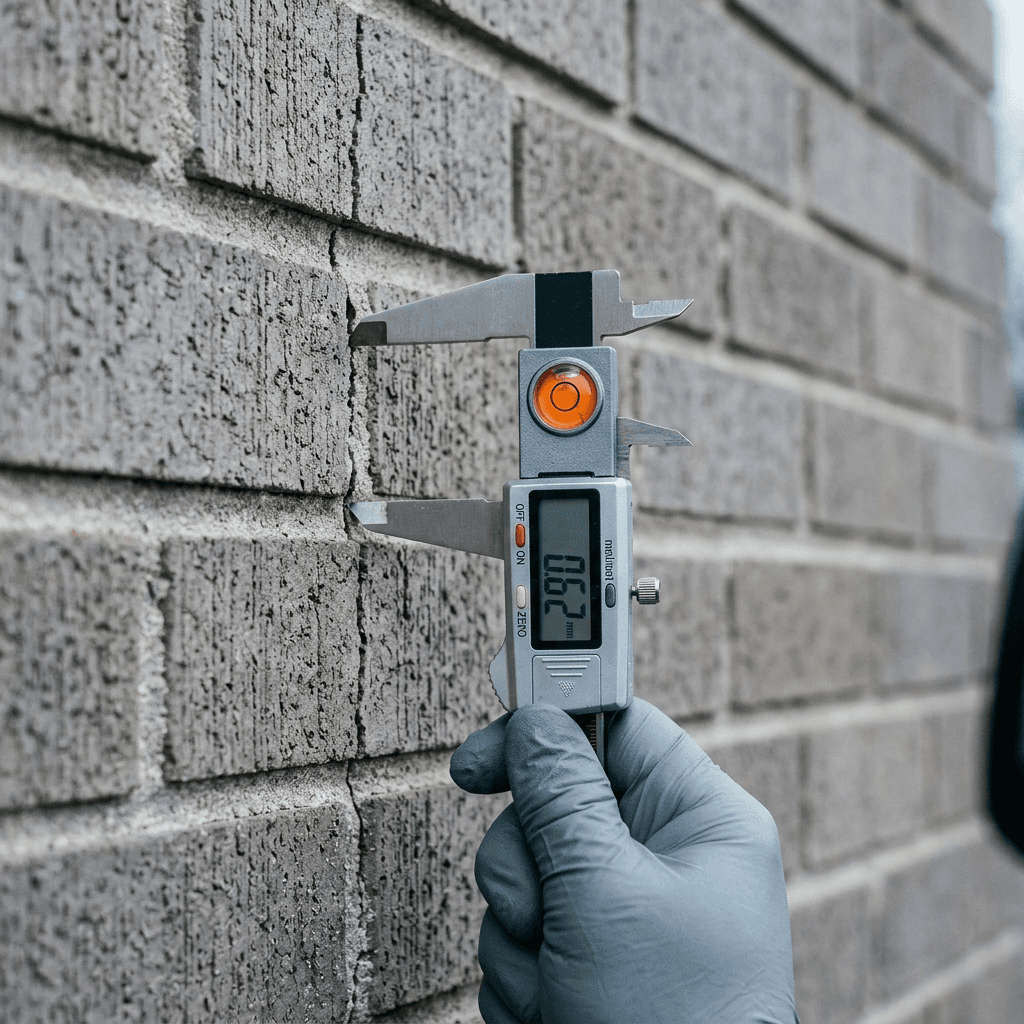
Width gets measured and dated, then measured again. A crack that grew between visits is a movement problem whatever its size; one that did not is a finish problem.
Four cracks, four different answers
Hairline slab cracks
Drying shrinkage and thermal movement crack almost every slab ever poured. Tight, no offset, not growing: a sealant if water or insects are getting in, otherwise nothing.
Stair-step cracks in brick
Mortar joints give way diagonally, one course at a time, when one section of the foundation settles relative to the next. Ones that run toward doors, windows and corners get the most attention.
Diagonal drywall cracks and sticking doors
Cracks running off the corners of door and window frames, with doors that no longer latch, are the symptoms engineers list for a deflecting foundation. Treated together, not one patch at a time.
Offset or lined-up cracks
A slab crack with one side higher than the other, or tile and grout cracking in a straight line, is movement, not shrinkage. That is the one to measure first.
The 1/8-inch and 1/4-inch widths inspectors quote are rules of thumb, not engineering standards. Behavior over 30 to 60 days tells you more than width does.
Houston's own engineers wrote a paper about it
The Foundation Performance Association, the Houston engineering group that publishes the local evaluation guidelines, has a whole committee paper titled “Distress Phenomena Often Mistakenly Attributed to Foundation Movement.” Framing that moves with the seasons and finishes that move with the temperature crack too. The elevation survey is how we separate them: if the floor reads inside tolerance and tilt is under 1 percent, you have a finish problem, and we will tell you so instead of selling you piers.
Stabilize, then fill, then finish
Survey
Floor elevations across the slab, crack widths measured and dated. This decides whether anything beyond step three is needed.
Stop the movement
Piers under the settled section, drainage and tree management where water is the cause. Skipped when the survey reads inside tolerance.
Inject or seal
Structural slab cracks from about 1/32 inch up are pressure-injected with epoxy to restore stiffness. Post-tension cables are tested and re-stressed after injection, in that order.
Repoint and patch
Brick is repointed and drywall patched after the house has resettled from any lift, so the cosmetic work is done once.
Why Houston in particular: the Lake Charles clay under much of the metro opens cracks half an inch to two inches wide at the surface when it dries, a foot or more deep, for 60 to 90 days in a typical year. The slab rides on that. Injection costs little next to the piers; the cost page has the ranges.
Crack repair questions
- Should I worry about a crack in my slab foundation?
- Usually not on its own. The Texas engineering guideline notes that most cracks do not compromise structural integrity; hairline cracks from concrete shrinkage are normal. Worry when a crack has one side higher than the other, when it lines up with sticking doors and diagonal drywall cracks, or when it keeps growing between measurements.
- How wide does a foundation crack have to be before it is a problem?
- Inspectors use rules of thumb, not standards: monitor anything past about 1/8 inch and get a crack past 1/4 inch evaluated. Width matters less than behavior. Mark both ends, date them, and re-measure in 30 to 60 days. A crack that moved is a movement problem whatever its width.
- Can you just fill foundation cracks with epoxy?
- Only after the movement that opened them has been stopped. Pressure-injected epoxy restores stiffness across slab cracks of roughly 1/32 inch and wider, but injected into a slab that is still settling it simply fails next to the old crack. If the only goal is keeping water or insects out, a flexible sealant is the right material, not epoxy.
- Will the cracks come back after foundation repair?
- In the areas that were stabilized, the old cracks should not re-open, though the lift itself can produce a few new hairlines in finishes while the house resettles. Areas that were not underpinned are not protected by the repair, which is why the scope should say exactly which walls are covered.
Find out what the crack is telling you
A free evaluation reads the floor, not just the crack, so you fix the cause once instead of the symptom every spring.